
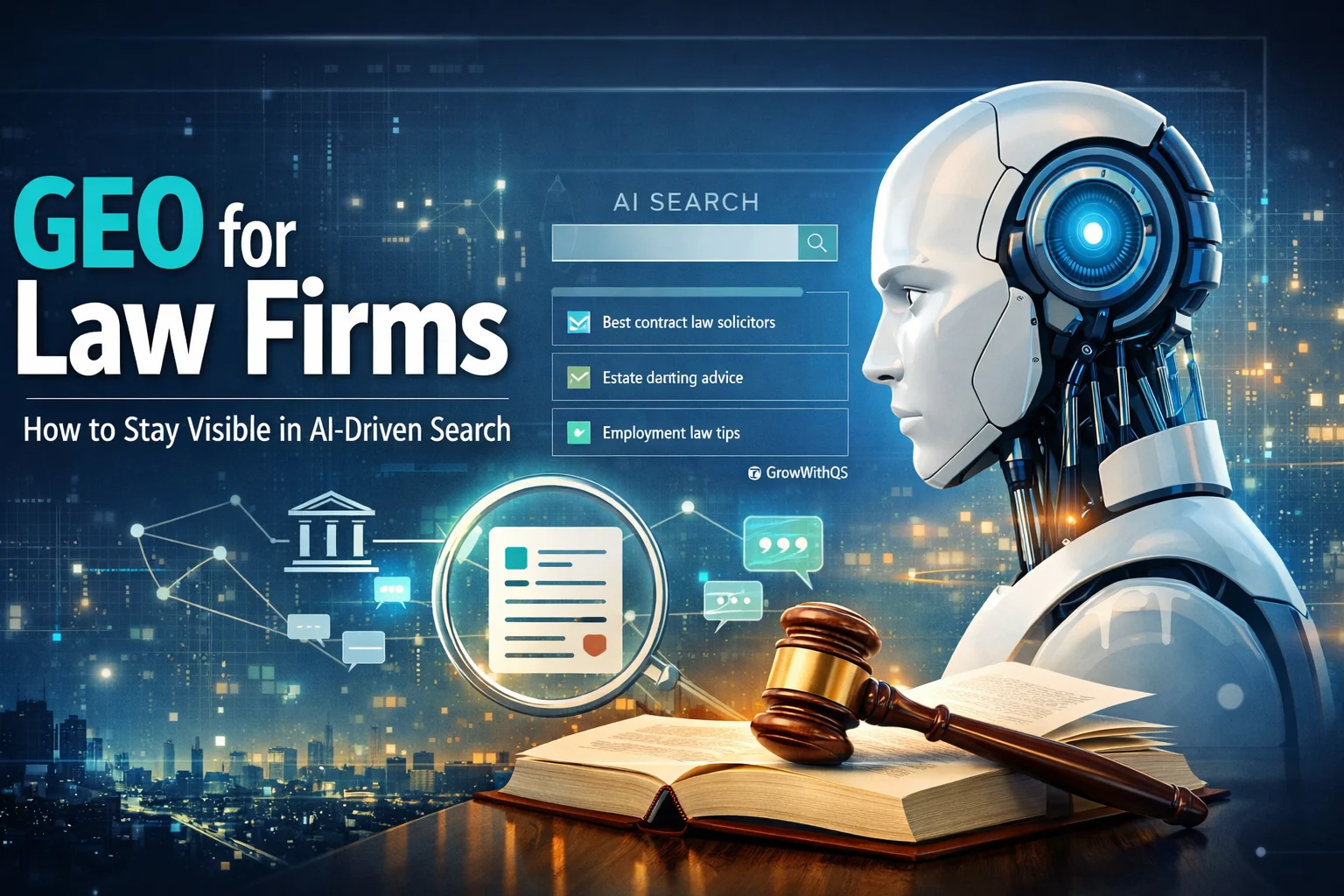

Generative Engine Optimisation (GEO):
How Law Firms Stay Visible in an AI-Driven Search World
Search has changed — quietly, but fundamentally.
People still “Google” questions, but increasingly they get answers without ever clicking a result. Tools like ChatGPT, Google AI Overviews, Perplexity, and Copilot now sit between your potential clients and the information they’re looking for.
That shift has given rise to Generative Engine Optimisation (GEO) — the practice of ensuring your content is retrieved, understood, and referenced by AI systems when they generate answers.
Traditional SEO is no longer the full picture. GEO is how firms stay visible when the answer comes first and the links come later — or not at all.
What is Generative Engine Optimisation (GEO)?
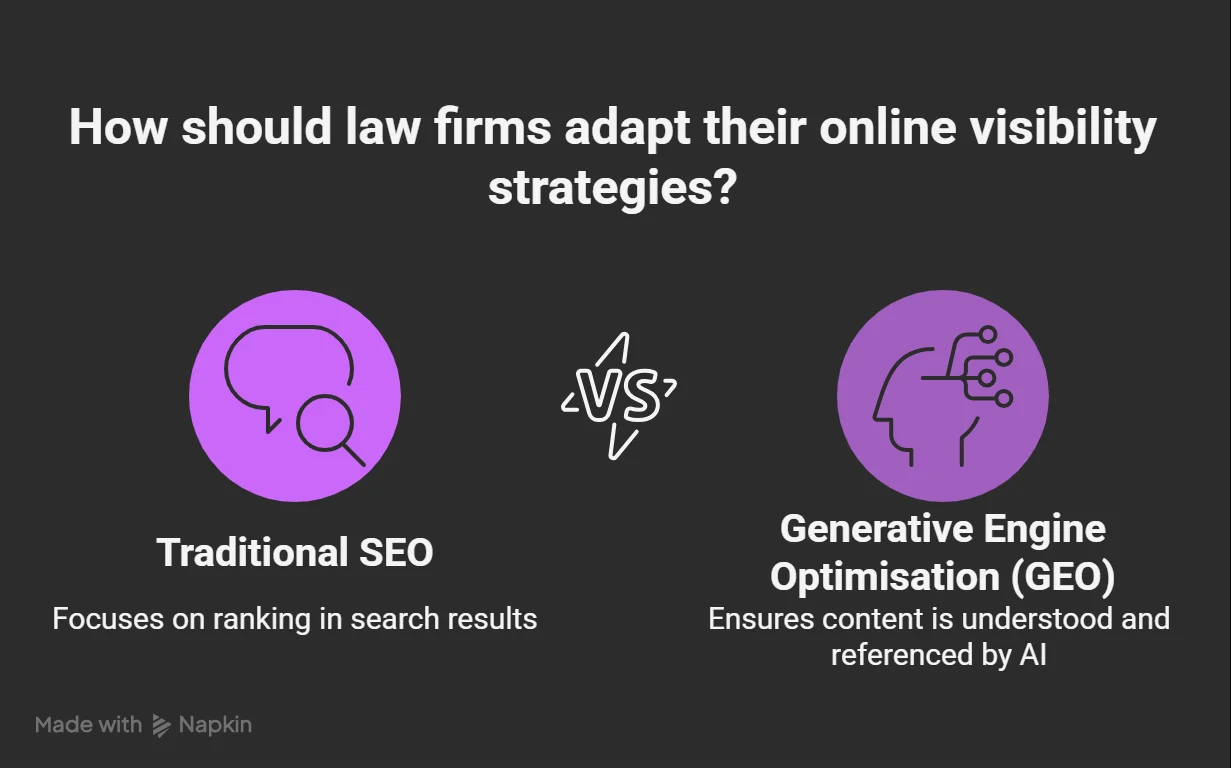
Generative Engine Optimisation is the process of optimising your content so it can be used and cited inside AI-generated responses, not just ranked in traditional search results.
Where classic SEO focuses on:
- Keywords
- Rankings
- Click-throughs
GEO focuses on:
- Inclusion
- Interpretation
- Citation
In other words: Is your firm part of the answer when AI explains, compares, or recommends?
Why visibility now happens inside the answer
Historically, search visibility meant competing for position on a page of blue links.
AI-driven search works differently.
Instead of presenting ten options, AI systems:
- Interpret the question
- Retrieve information from multiple sources
- Synthesize a single response
The real competition now happens inside that response, not underneath it.
For law firms, this matters because:
- Clients increasingly ask AI tools legal and commercial questions
- AI systems frame the options before a user ever visits a website
- Being mentioned can matter as much as being clicked
Visibility today is not just about traffic. It’s about influence at the point of understanding.
SEO hasn’t disappeared — it has expanded
The foundations of SEO still matter:
- Technical quality
- Authority
- Relevance
- Crawlability
But they now operate within generative systems that prioritise:
- Clear structure
- Strong entity understanding
- Reliable sources
- Low-risk, verifiable information
GEO doesn’t replace SEO. It builds on it — ensuring your content is legible not just to people, but to the AI systems increasingly guiding discovery.
Understanding the new terminology
As search evolves, so does the language around it. These terms are related, but they describe different layers of the same ecosystem.
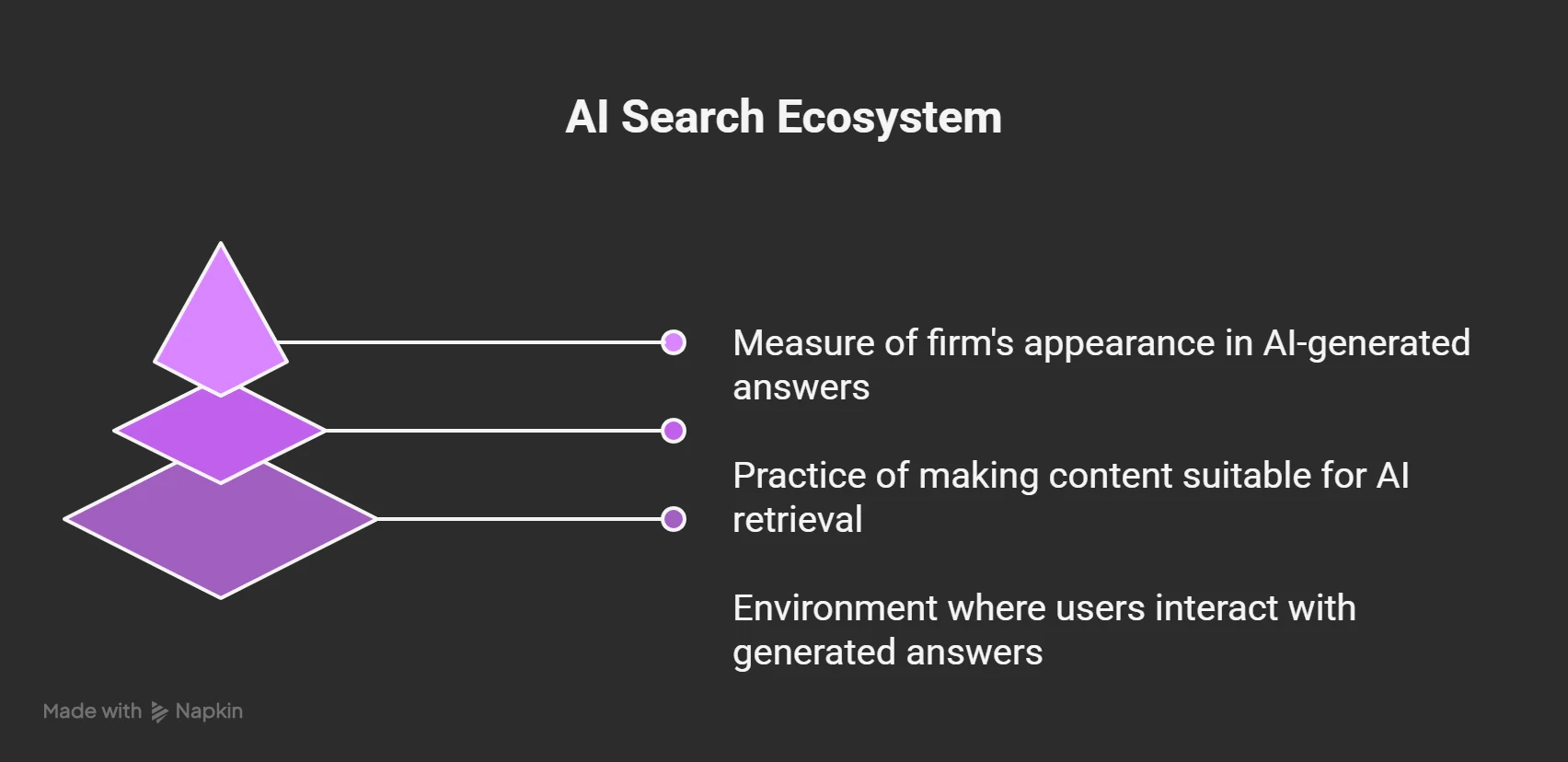
AI Search: the environment
AI search refers to the growing number of tools where users interact directly with generated answers rather than lists of links. This includes AI Overviews, ChatGPT Search, Perplexity, and similar platforms.
For firms, this is fast becoming the new front door — shaping trust and perception before a client ever reaches your site.
AI SEO: the practice
AI SEO is the practical work of making content suitable for AI-driven retrieval. It blends traditional SEO with:
- Clear entity definition
- Structured explanations
- Original insight
- Formatting that AI can safely reuse
The goal isn’t just to rank pages — it’s to ensure AI systems can confidently reference your expertise.
AI visibility: the outcome
AI visibility measures how often, how accurately, and in what context your firm appears within AI-generated answers.
It shifts the focus from:
“How much traffic did we get?”
to:
“Are we being represented correctly when decisions are being formed?”
GEO vs traditional ranking signals
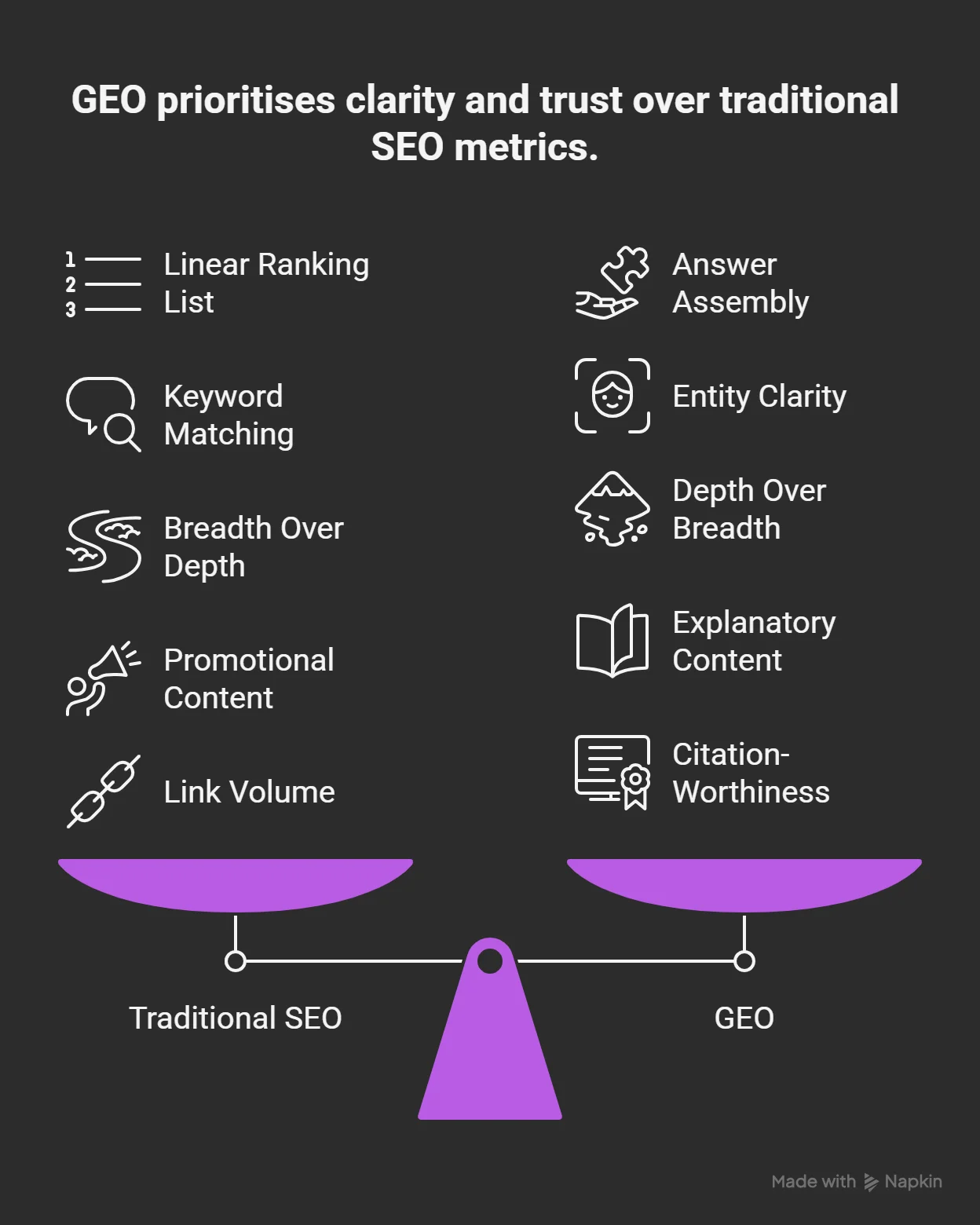
AI systems don’t rank pages in a linear list. They assemble answers.
To do that, they rely less on pure keyword matching and more on:
- Entity clarity
- Semantic depth
- Consistency across trusted sources
- Citation-worthiness rather than link volume
For law firms, this means:
- Clear definition of who you are and what you do
- Depth over breadth
- Content that explains, not just promotes
- Signals that your information is safe to reuse
E-E-A-T still matters, but it’s interpreted differently. AI systems infer expertise and trust not just from your website, but from how consistently your firm appears across the wider knowledge ecosystem.
The zero-click reality (and why it’s not all bad)
Search has been moving towards zero-click for years. AI accelerates it.
Many queries now:
- Start with AI
- End with AI
- Never reach a website
This creates a paradox:
- Traffic may decline
- Influence can increase
A firm might receive fewer visits, yet:
- Be cited in explanations
- Shape how options are framed
- Be perceived as authoritative
The real risk isn’t reduced clicks — it’s invisibility or misrepresentation.
If your content is unclear, poorly structured, or hard to verify, AI systems may:
- Ignore it
- Paraphrase it inaccurately
- Attribute insights elsewhere
GEO focuses on making your expertise extractable without distortion.
8 practical GEO considerations for law firms
1. Structure content for reuse
AI systems favour clarity. Use:
- Clear headings
- Bullet points
- Tables and comparisons
- Direct explanations
If a key point is buried in narrative prose, it’s less likely to be reused.
2. Be explicit about entities
Your firm, services, locations, and expertise should be named consistently.
Schema helps, but so does context:
- Who you are
- What you specialise in
- How you differ
- Where your authority comes from
Confusion reduces trust — even when content is strong.
3. Make content easy to parse
Shorter sections, clear claims, and visible evidence matter.
AI systems prefer:
- FAQs
- Defined answers
- Statements backed by sources
- Clear author and date signals
This is especially important in legal and financial topics.
4. Keep dates honest and consistent
Freshness matters — but only when it’s credible.
Ensure:
- Publish dates align with updates
- Schema and on-page dates match
- Evergreen content is clearly positioned
Conflicting date signals can cause AI systems to skip your content entirely.
5. Build mentions, not just links
Authority now comes from corroboration.
Mentions in:
- Industry publications
- Trusted directories
- Professional commentary
- Partner content
All reinforce that your expertise is recognised beyond your own site.
6. Show up beyond your website
AI systems learn from:
- Articles
- LinkedIn posts
- Videos
- Podcasts
- Industry discussions
Consistency across channels helps AI understand what you’re known for — and when to surface you.
7. Answer real client questions
AI thrives on practical clarity.
Content that performs well often:
- Explains trade-offs
- Covers edge cases
- Addresses uncertainty
- Helps users make decisions
This mirrors how prospective clients actually think.
8. Strengthen the overlap with SEO fundamentals
Internal linking, site structure, authority, and depth still matter — they just influence eligibility, not rankings alone.
Strong SEO foundations make GEO easier, not harder.
What visibility means going forward
In an AI-driven search world, visibility is no longer just about position.
It’s about:
- Being selected
- Being trusted
- Being reused
The firms that win are those with:
- Clear expertise
- Strong entity signals
- Consistent recognition across the web
GEO doesn’t change the principles of good SEO — it changes what those principles unlock.
The question is no longer:
“Do we rank well?”
It’s:
“Are we part of the answer?”
Where AI SEO Fits In
Generative Engine Optimisation (GEO) is only one part of a much bigger shift in how legal services are discovered online.
While GEO focuses on how your content is interpreted and surfaced by AI tools, the wider challenge is ensuring your entire digital presence is structured in a way that search engines—and AI platforms—can trust, understand, and prioritise.
This is where AI SEO comes in.
AI SEO goes beyond individual pieces of content. It looks at your website as a whole—your structure, authority, content depth, and how clearly you demonstrate expertise in your key practice areas.
If your firm isn’t actively adapting in this way, you’re not just missing opportunities—you’re becoming less visible in the channels that are already replacing traditional search.
👉 Learn more about how this works in practice on our AI SEO service page:
https://growwithqs.com/ai-seo/
Conclusion
As AI continues to reshape how people search for legal information, law firms must evolve beyond traditional SEO if they want to stay visible and competitive. Generative Engine Optimisation (GEO) isn’t just a new buzzword — it’s a strategic response to the reality that answers increasingly come from AI systems, not search result pages. When firms optimise for retrieval, clarity, and citation in AI-generated responses, they protect and amplify their presence at the very moment clients form preferences and make decisions.
This shift isn’t hypothetical — it’s already underway. As outlined in our analysis of how AI search is rewriting visibility for law firms and creating a critical inflection point going into 2026, firms that fail to adapt risk becoming invisible even if they previously ranked well on Google.
Likewise, our deep dive into AI’s impact on the legal sector in 2025 shows how AI-driven discovery has transformed client behaviour and the competitive landscape for legal services.
FAQs
1. What is GEO and why does it matter for law firms?
GEO (Generative Engine Optimisation) refers to optimising content so AI systems — like ChatGPT, Google AI Overviews, and Perplexity — can retrieve, interpret, and cite it within generated answers. For law firms, this means being included in the part of the search experience where users make decisions, rather than just chasing clicks on traditional search results pages.
2. How is GEO different from traditional SEO?
Traditional SEO focuses on ranking webpages using keywords, links, and SERP positions. GEO focuses on being present and cited within AI-generated responses, emphasising entity clarity, structured content, and trust signals that help generative tools confidently use your content in answers.
3. Will GEO replace traditional SEO entirely?
Not exactly. Traditional SEO fundamentals — such as technical hygiene, relevance, and authority — remain important. However, GEO expands these foundations with an AI-centric playbook designed to ensure content is accessible and trustworthy for AI systems that increasingly mediate discovery.
4. Can GEO impact client enquiries?
Yes. When content is cited in AI-generated answers, it increases awareness and trust — and this can lead to more enquiries, even if users don’t click through in the traditional sense. GEO helps firms be recognised and recommended at the earliest stage of consideration.
5. Is GEO relevant only for large firms?
No. Firms of all sizes can benefit from GEO by focusing on clear, structured, and authoritative content tailored to real client needs. Smaller and specialist firms that articulate their expertise well are often more likely to stand out in AI-driven discovery, especially for niche queries.
6. How quickly is AI search affecting the legal sector?
Rapidly. AI-mediated search and discovery are already reshaping how potential clients find legal information, and by 2026, firms that haven’t adapted to AI-first discovery risk significant visibility loss. Early adoption of GEO principles helps firms stay ahead of this shift.