

Why high-quality enquiries matter more than ever in 2026
In 2026, the challenge for regional and local law firms is no longer simply generating enquiries. Most firms can do that to some degree. The real challenge is generating the right enquiries — enquiries that align with a firm’s services, capacity, pricing model and long-term profitability.
Data from the GrowWithQS report Regional Law Firms Can Boost Profitability in 2025 remains highly relevant going into 2026. It shows that firms focusing purely on enquiry volume often experience rising costs, operational pressure and inconsistent profitability. In contrast, firms that prioritise enquiry quality, conversion rate and matter value are far better placed to grow sustainably.
Layer on top of this the findings from AI Search and the Legal Sector in 2025, and a clearer picture emerges. Search behaviour is changing rapidly. AI-driven results are reshaping how potential clients discover, evaluate and choose law firms. Visibility alone is no longer enough — firms must demonstrate relevance, authority and clarity at every stage of the journey.
So the key question for 2026 is not:
“How do we get more enquiries?”
But instead:
“How do we consistently generate high-quality client enquiries that convert into profitable instructions?”
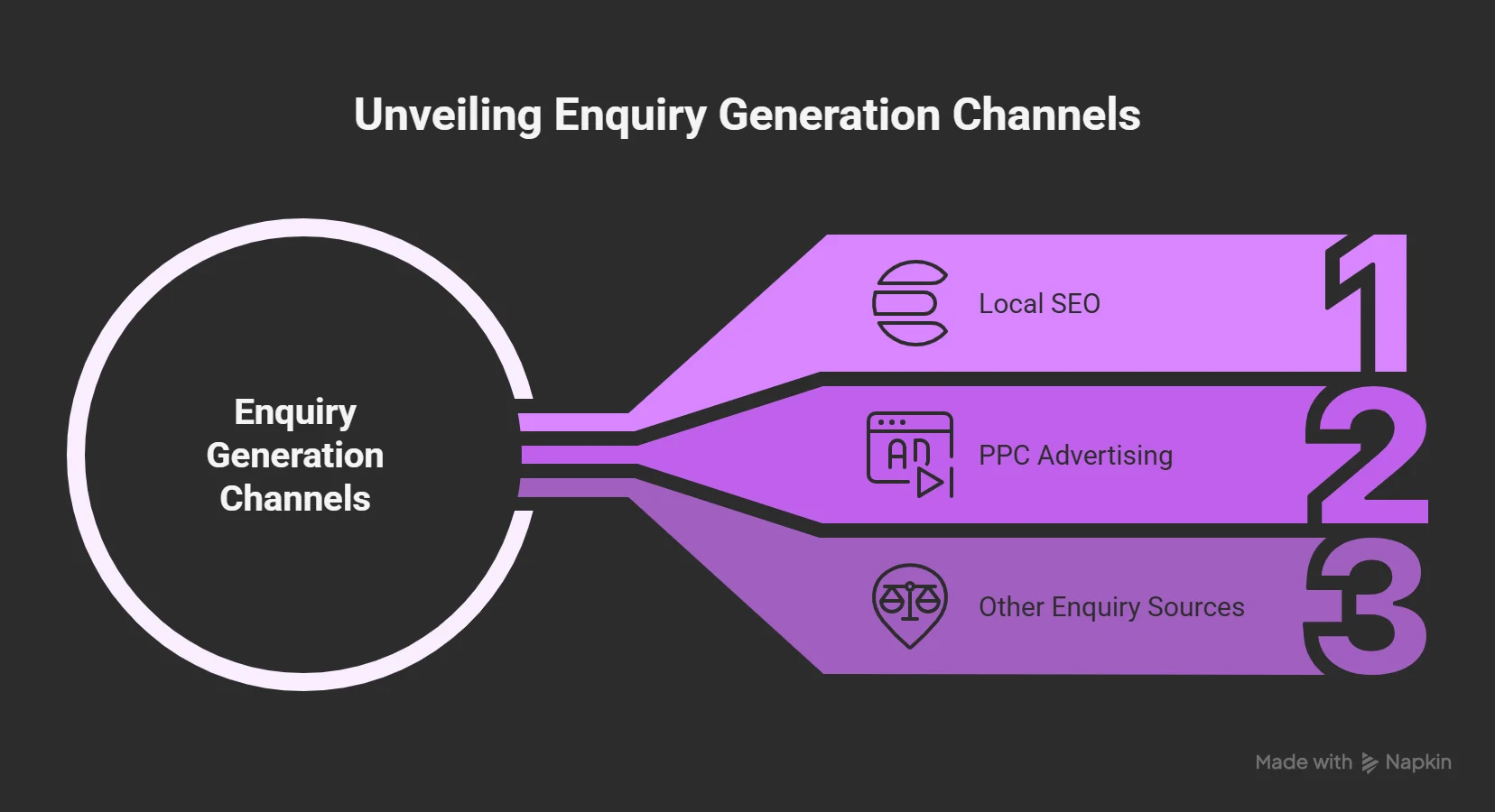
This article explores that question through three core enquiry-generation channels:
- Local SEO
- PPC (Pay-Per-Click advertising)
- Other enquiry sources, including QualitySolicitors (QS)
Rather than listing tactics, we’ll look at how each channel works in practice, the level of investment and commitment required, and the realistic pros and cons for regional and local firms in 2026.
What defines a high-quality client enquiry for a law firm?
Before assessing any marketing channel, it’s essential to agree on what “high quality” actually means.
A high-quality client enquiry is not simply someone who fills in a form or makes a phone call. In practical terms, high-quality enquiries tend to share several characteristics. They come from individuals or businesses with a clear and immediate legal need, a realistic expectation of cost, and a problem that genuinely matches the firm’s expertise and location.
Importantly, high-quality enquiries also convert more efficiently. They require fewer follow-ups, lead to clearer conversations about fees, and progress to instruction at a higher rate. Over time, this has a direct impact on profitability, staff workload and client satisfaction.
The GrowWithQS profitability data consistently shows that firms improving conversion rates by even a small margin often outperform firms generating significantly more enquiries but converting poorly.
Local SEO in 2026: capturing intent at the moment it matters
What is Local SEO for law firms?
Local SEO focuses on ensuring a law firm appears prominently when potential clients search for legal services in a specific geographic area. These searches are typically highly intent-led and include phrases such as:
- “Family solicitor near me”
- “Conveyancing solicitor in [town or city]”
- “Employment law advice local solicitor”
In 2026, these searches are increasingly influenced by AI-driven search results, which draw on website content, Google Business Profiles, reviews and local authority signals to surface the most relevant firms.
Why Local SEO generates high-quality enquiries
Local SEO works so well because it captures clients at the point of need. The user is not browsing or researching abstract legal concepts; they are actively looking for a solicitor who can help them now, in their area.
When executed properly, Local SEO attracts enquiries from people who already understand the type of service they require and are comparing providers. This naturally leads to higher-quality conversations and stronger conversion rates.
AI search is reinforcing this behaviour. According to the AI Search report, Google and other platforms are prioritising locally relevant, authoritative and clearly structured content when generating AI-powered summaries. Firms that explain their services clearly and demonstrate local expertise are more likely to be surfaced — even if they are not the largest firm in the area.
Investment and commitment required
Local SEO is often described as a long-term investment, and that remains true in 2026. While it does not require ongoing ad spend in the same way PPC does, it does require consistent effort and resource.
This typically includes:
- Technical website optimisation to ensure pages load quickly and meet modern search standards
- Creation of locally focused service pages that reflect how clients actually search
- Ongoing optimisation of Google Business Profiles
- Generation and management of client reviews
- Regular content updates that answer real client questions
The commitment here is as much about mindset as budget. Firms must be willing to view Local SEO as an ongoing process rather than a one-off project.
Pros and cons of Local SEO
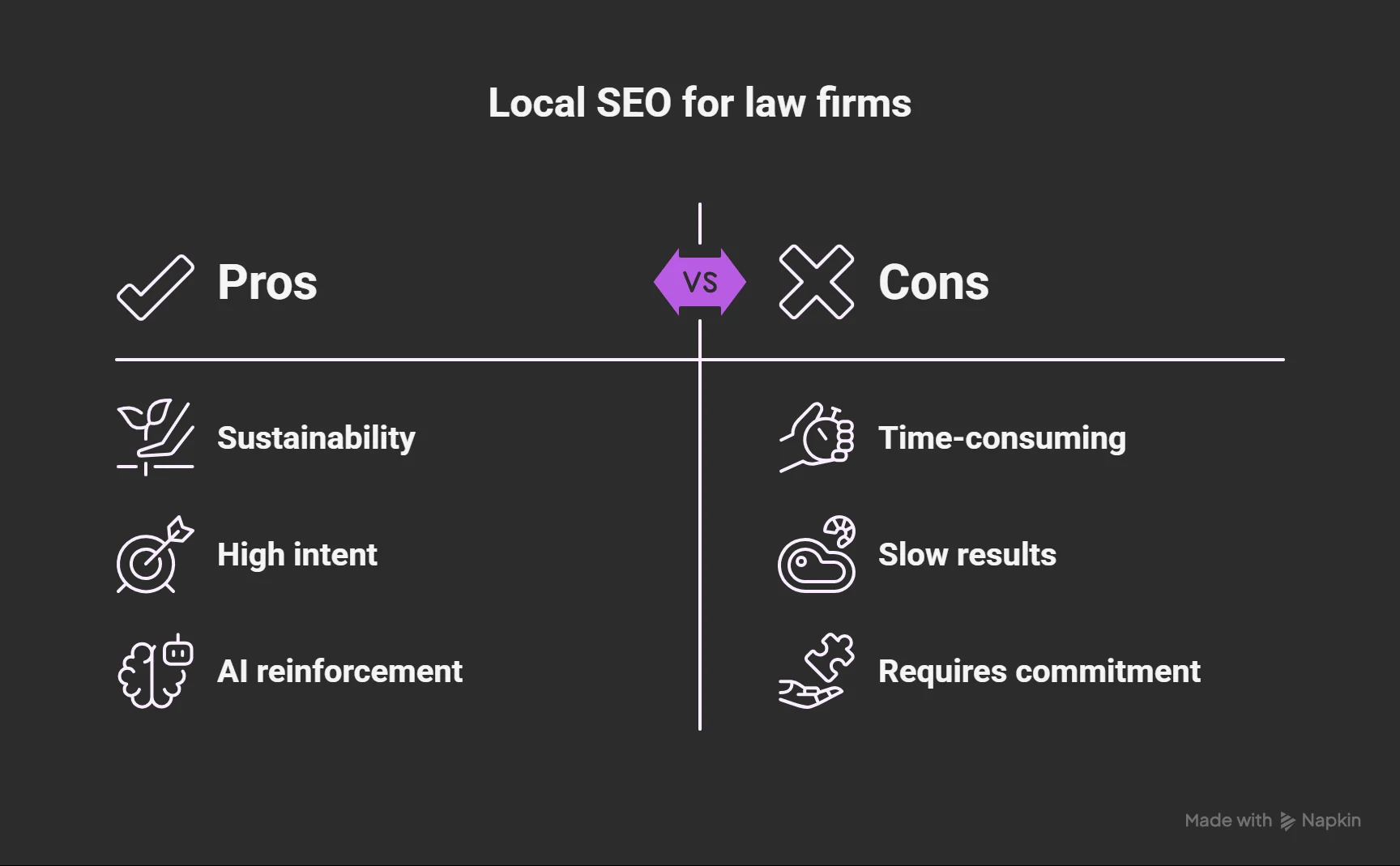
Local SEO’s biggest strength is sustainability. Once visibility is established, it can deliver a steady stream of high-intent enquiries without incremental cost per click.
However, the trade-off is time. Results are rarely immediate, particularly in competitive locations. Firms that need enquiries urgently may find Local SEO frustrating if relied on in isolation.
Local SEO works best for firms that are thinking long term and want to build a durable pipeline of high-quality enquiries.
PPC in 2026: control, speed and precision — at a cost
How PPC works for law firms
PPC advertising allows law firms to appear immediately at the top of search results for selected keywords. Unlike Local SEO, visibility is paid for rather than earned over time.
In 2026, PPC remains one of the fastest ways to generate enquiries, particularly for competitive practice areas such as family law, conveyancing and employment law.
Why PPC can deliver high-quality enquiries
When structured correctly, PPC targets users who are already demonstrating strong intent. Carefully chosen keywords, tightly defined geographic targeting and clear ad messaging all help to filter out low-quality traffic.
The GrowWithQS data shows that firms achieving the best results from PPC focus on specific services and locations, rather than broad, generic keywords that attract unfocused enquiries.
Landing pages also play a crucial role. PPC traffic that is sent to clear, service-specific pages converts at a significantly higher rate than traffic sent to generic homepage content.
Investment and commitment required
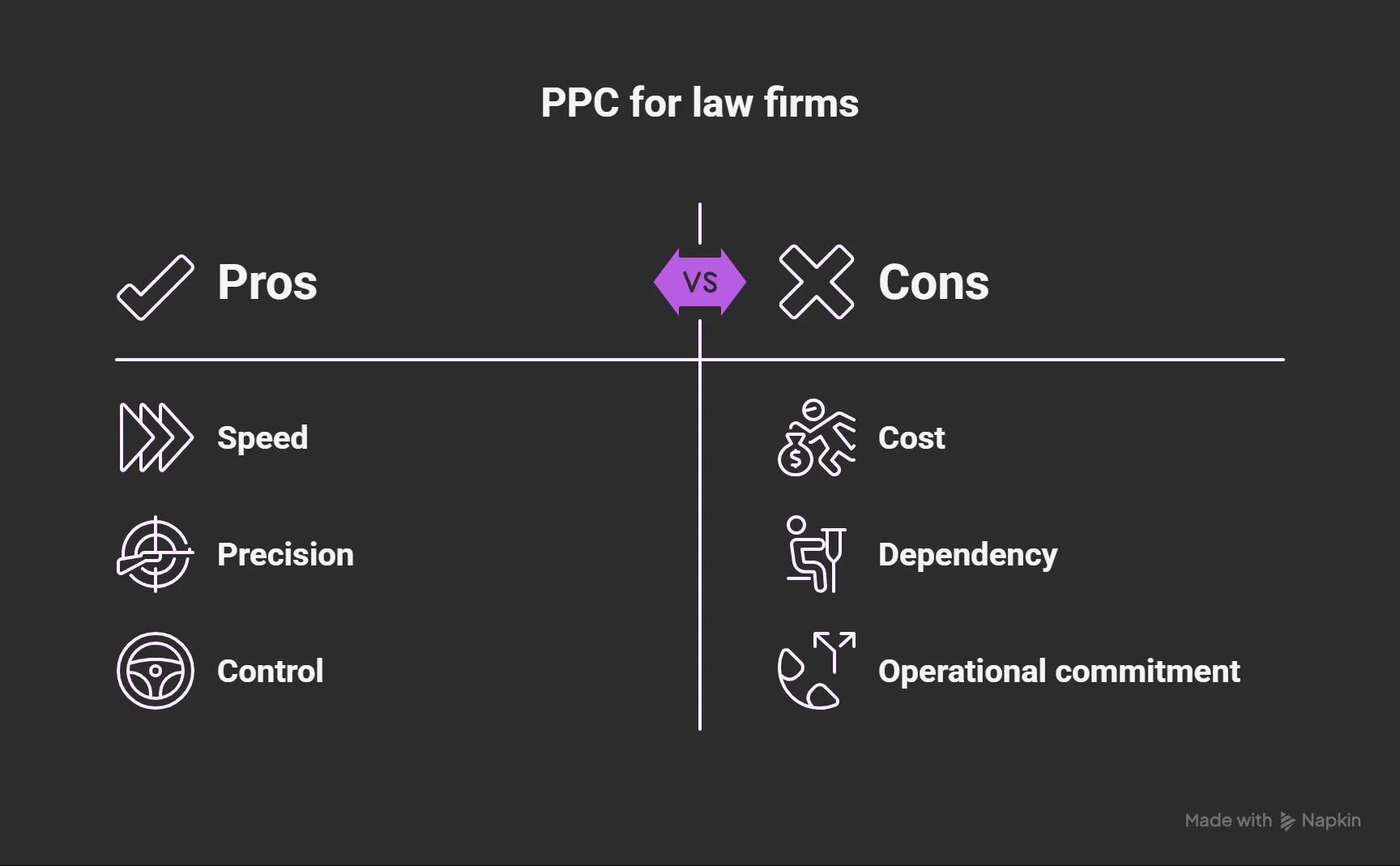
PPC requires a dual investment: ongoing ad spend and professional campaign management. Legal keywords remain expensive in 2026, and poorly managed campaigns can burn through budget quickly without delivering meaningful results.
Beyond cost, PPC demands operational commitment from the firm. Enquiries generated via PPC often arrive quickly and in volume. Firms that respond slowly or inconsistently see conversion rates drop sharply, regardless of lead quality.
Pros and cons of PPC
The key advantage of PPC is speed. Campaigns can be launched quickly, adjusted in real time and scaled up or down as required.
The downside is dependency. Once spend stops, visibility disappears. PPC can also expose weaknesses in internal processes, such as poor enquiry handling or unclear pricing conversations.
PPC works best as part of a broader strategy, rather than as a standalone solution.
Other enquiry sources in 2026: diversification and reach through QS
Why third-party enquiry sources still matter
Despite shifts in AI search and organic visibility, third-party platforms continue to play an important role in enquiry generation. For many regional and local firms, these sources provide access to demand that would be difficult or costly to generate independently.
QualitySolicitors (QS), in particular, combines national brand recognition with strong online visibility and public trust. This allows member firms to benefit from enquiries across multiple practice areas without relying solely on their own digital presence.
Benefits of using QS and similar platforms
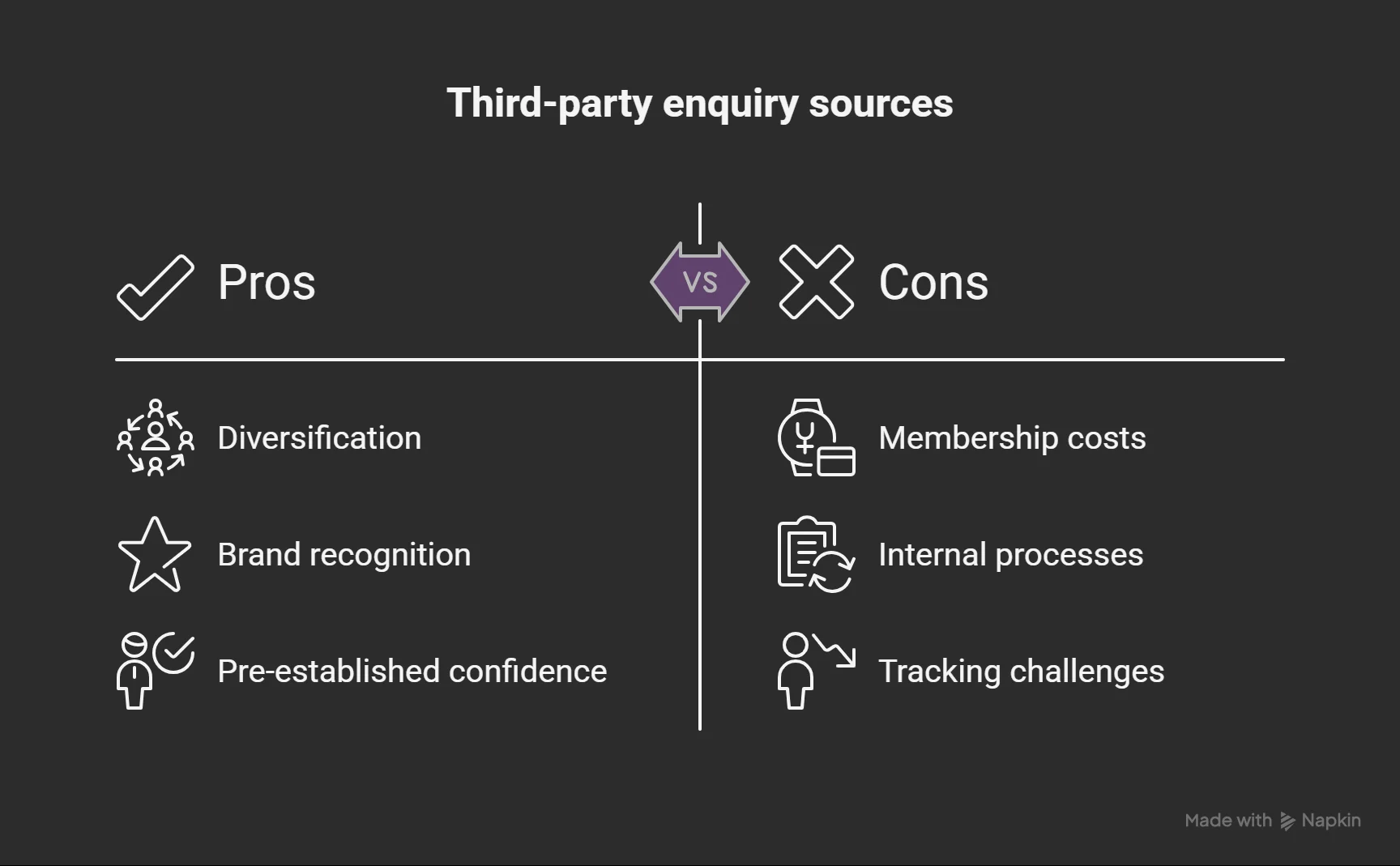
One of the key advantages of QS is diversification. Rather than relying on a single marketing channel, firms can spread risk and smooth fluctuations in enquiry volume.
Additionally, enquiries generated through trusted platforms often arrive with a degree of pre-established confidence. Clients recognise the brand, which can shorten decision-making and improve initial engagement.
Investment and commitment required
Third-party enquiry sources typically involve a fixed membership or subscription cost. While this makes budgeting more predictable than PPC, the real return depends heavily on how firms manage enquiries internally.
This is where challenges often arise.
The real cons: internal processes and tracking
The main limitation of third-party enquiry sources is not the quality of enquiries themselves, but the firm’s ability to track, manage and convert them effectively.
Many regional and local firms still lack:
- Consistent conversion tracking by source
- Clear follow-up processes
- Feedback loops between marketing and fee earners
Without this visibility, it becomes difficult to assess true ROI or identify opportunities for improvement.
When firms address these issues, third-party enquiries can become a highly effective component of a wider enquiry strategy.
How AI search is reshaping enquiry generation in 2026
AI-driven search continues to reduce superficial browsing while increasing intent. Users are asking more specific questions and expecting clearer answers.
For law firms, this means:
- Fewer, but better-quality clicks
- Greater emphasis on expertise and clarity
- Increased importance of locally relevant information
Firms that explain their services in plain language, answer common client questions and demonstrate authority are more likely to be referenced by AI-generated results.
What is the most effective enquiry strategy for law firms in 2026?
There is no single channel that guarantees success. High-performing firms typically combine:
- Local SEO for long-term visibility and trust
- PPC for speed and precision
- Trusted third-party sources like QS for diversification
Crucially, they also invest in conversion tracking, enquiry handling and ongoing review.
Key takeaways
As regional and local law firms move through 2026, one message is clear: the firms performing best are not those generating the most enquiries, but those generating the right ones.
High-quality client enquiries are defined less by volume and more by intent, relevance and the likelihood of conversion. Firms that prioritise these factors consistently see stronger profitability, better client experiences and more sustainable growth.
A common theme across high-performing firms is balance. Local SEO, PPC and third-party enquiry sources each serve a different purpose, and none should be relied upon in isolation. Local SEO builds long-term visibility and trust within a firm’s geographic market. PPC provides speed, control and the ability to respond quickly to demand. Trusted platforms such as QualitySolicitors offer diversification, reach and brand credibility that many firms would struggle to replicate on their own.
Equally important is what happens after an enquiry arrives. Many challenges attributed to “lead quality” are, in reality, the result of internal processes. Slow response times, inconsistent follow-up and limited conversion tracking can significantly reduce the value of otherwise strong enquiries. Firms that take time to review and improve how enquiries are handled often unlock meaningful gains without increasing marketing spend.
Finally, AI-driven search is not changing what clients want — it is amplifying it. Clients still look for clarity, confidence and reassurance that they are choosing the right solicitor for their situation. Firms that communicate clearly, demonstrate local expertise and explain their services in plain language are best placed to be visible, trusted and chosen.
In 2026, generating high-quality client enquiries is not about chasing new tactics. It is about combining proven channels, committing to consistent execution and treating enquiry conversion as a strategic priority, not an afterthought.
Frequently Asked Questions
What is a high-quality client enquiry for a law firm?
A high-quality client enquiry comes from someone with a clear and immediate legal need that aligns with the firm’s services, location and capacity. These enquiries tend to convert more easily, involve more productive conversations around fees and scope, and are more likely to result in profitable instructions.
Is generating more enquiries always better for law firms?
No. Increasing enquiry volume without considering quality often leads to lower conversion rates, higher operational pressure and reduced profitability. Many firms see better results by focusing on fewer, better-matched enquiries rather than maximising volume alone.
Which enquiry generation channel works best in 2026?
There is no single “best” channel. The most effective strategies typically combine Local SEO for long-term visibility, PPC for speed and control, and trusted third-party sources for diversification. The right mix depends on the firm’s practice areas, location and growth objectives.
Is Local SEO still effective with AI-driven search results?
Yes. AI-driven search places greater emphasis on local relevance, authority and clearly explained services. Law firms with strong local signals and helpful, well-structured content are more likely to be surfaced in AI-powered search results.
Why do some law firms struggle to convert enquiries into instructions?
In many cases, the issue is not the enquiry source but internal processes. Slow response times, inconsistent follow-up, unclear pricing conversations and limited tracking can all reduce conversion rates, even when enquiry quality is high.
How many enquiry sources should a regional or local law firm use?
Most successful firms rely on two or three complementary enquiry sources. This reduces dependency on any single channel, helps smooth fluctuations in demand and provides a more stable flow of enquiries throughout the year.
How can firms improve enquiry conversion without increasing marketing spend?
Improving enquiry handling often delivers the fastest gains. Faster response times, clearer initial conversations, consistent follow-up and better tracking of outcomes can significantly increase conversion rates without any additional marketing investment.