



The Quiet Underinvestment in Legal Marketing
If you run a high street law firm, you probably already know that marketing feels like a cost rather than an investment. Between managing caseloads, meeting compliance requirements, and retaining staff, marketing budgets are often the last thing on the agenda, and the first thing to be trimmed. But what if that mindset is quietly costing your firm thousands of pounds in missed instructions every single year?
Across almost every industry, businesses treat marketing as a core driver of revenue, not an optional extra. Retailers, technology companies, financial services firms, and even healthcare providers all invest significantly in their marketing function. The legal sector, by contrast, remains one of the most underinvested industries when it comes to marketing spend relative to revenue — and the gap is wider than most firm owners realise. This article explores that gap, breaks down what it means in practice for a typical high street firm, and makes the case for four specific marketing investments that can genuinely transform your client pipeline: PPC advertising, SEO, review management, and online reputation building for AI discovery. The goal is not to suggest you spend recklessly, it is to help you spend smarter.
How Other Industries Think About Marketing Spend
To understand how the legal sector is falling behind, it helps to first look at what other industries are doing. According to Gartner’s 2025 CMO Spend Survey, the average company allocates 7.7% of total company revenue to marketing — and that figure represents a period of relative restraint following post-pandemic budget cuts. Historically, the long-term average has been closer to 12%.
Here is how the marketing spend picture looks across sectors:
- Technology & SaaS: 11–15% of revenue (startups often 20–30%)
- Retail & E-commerce: 10–20% of revenue
- Consumer Packaged Goods: Up to 18% of revenue
- Financial Services: 7–10% of revenue
- Healthcare: 5–12% of revenue
- B2B Professional Services: 8–11% of revenue
- Legal Services (UK average): 2–3.7% of revenue
Sources including Thomson Reuters, the Law Firm Marketing Club’s Professional Services Marketing Survey, and Contra Agency‘s analysis of UK law firm budgets consistently put the average legal sector marketing spend at between 2% and 3.7% of turnover. Within that range, high street and regional firms tend to sit at the lower end — often at or below 2% — while national claims firms and volume personal injury practices push the upper boundary, sometimes to 7–10%, given the high cost-per-acquisition environment they operate in.
That means the average UK law firm is spending less than a quarter of what a technology company spends, and roughly half of what a financial services firm allocates, when measured as a proportion of revenue. In a market where clients increasingly discover and compare solicitors online, this is not a minor discrepancy, it is a structural disadvantage.

What Does 2% Actually Look Like for a High Street Firm?
Let us bring this to life with a practical example. Consider a high street firm turning over £500,000 per year — a realistic figure for a small practice handling conveyancing, wills and probate, family law, and the occasional employment matter. At 2% of revenue, the annual marketing budget is £10,000. That sounds reasonable on the surface. But once you account for the basics, it disappears very quickly.
A typical 2% marketing budget for a high street firm might look like this:
- Website hosting, domain renewal & maintenance: £800–£2,000 per year
- Local directory listings (e.g. Yell, Thomson Local): £500–£1,000 per year
- Occasional local newspaper or magazine advert: £1,000–£2,500 per year
- Printed materials (leaflets, business cards, brochures): £800–£2,000 per year
- Sponsorship of a local event or community group: £500–£1,000 per year
That accounts for roughly £3,600 to £8,500 — and the remaining budget, if there is any, often gets absorbed into ad-hoc spend with little strategic direction. There is no ongoing SEO. There is no paid search. There is no structured review management. There is no social media strategy. And critically, there is no measurement of return.
This is not a criticism of the firms operating in this way — it reflects a deeply ingrained culture within the profession that views marketing with a degree of scepticism. Research by Conroy Creative Counsel found that as many as 95% of lawyers perceive marketing as a risk, in part because expenditure is non-billable and returns can be difficult to quantify directly. But that mindset is increasingly costly in an environment where competitors are investing more, and where clients have more choice and information than ever before.
The Law Firm Marketing Club’s Professional Services Marketing Survey found that the average law firm marketing budget has been rising — from 2.7% to 3.1% of turnover in their most recent data. That upward trend is encouraging, but it still leaves the legal sector well behind comparable professional services sectors. And for high street firms, the day-to-day reality is often closer to 2% than to 3%.
So what should firms be doing with more budget? Here are four high-impact channels that deserve serious consideration.
1. PPC (Pay-Per-Click): Measurable Return, Immediate Visibility
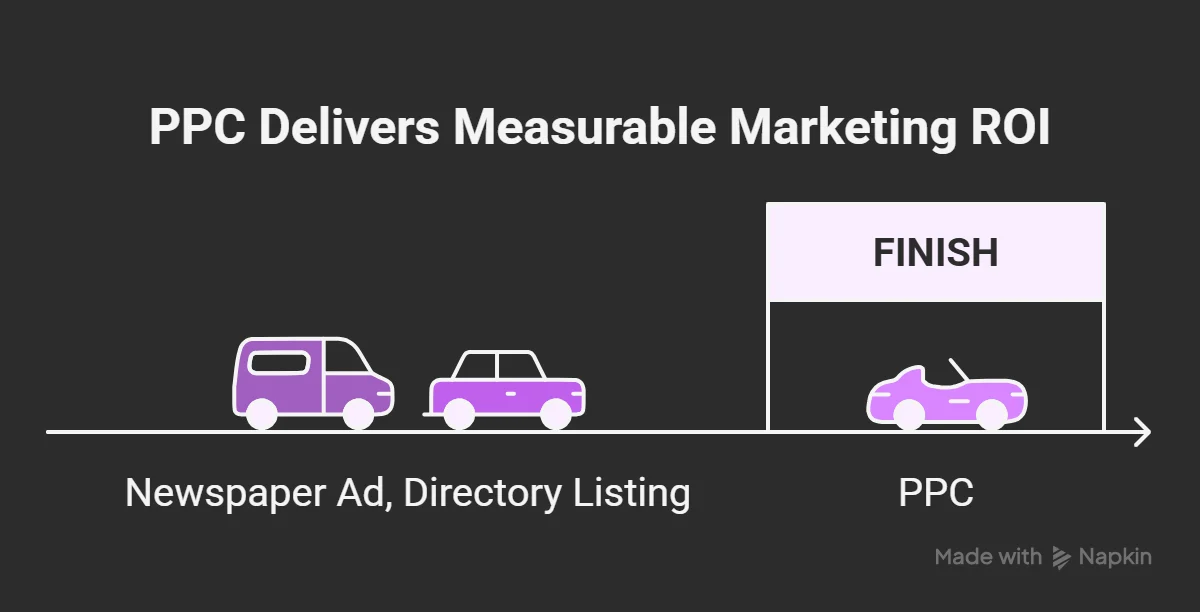
Pay-per-click advertising — primarily through Google Ads — is one of the most direct and measurable marketing channels available to law firms. Unlike a local newspaper advert or a listing in a directory, PPC puts your firm in front of a potential client at the precise moment they are actively searching for your services. Someone typing “conveyancing solicitor in Sheffield” or “family law advice near me” is not browsing — they are ready to take action.
The central metric to understand here is Return on Ad Spend (ROAS) — how much revenue your firm generates for every pound invested in advertising. Well-managed legal PPC campaigns can deliver strong ROAS, particularly in practice areas where case values are high. Legal web design specialists note that firms working with clean, up-to-date data and optimised campaigns can regularly exceed a 5:1 return, meaning £5 of fee income for every £1 spent on advertising. GrowwithQS members see an average 400%+ ROI on their PPC campaigns.
A strong conversion rate for legal PPC campaigns typically falls between 5% and 15%, meaning that between 5 and 15 out of every 100 clicks result in an enquiry. For context, a conveyancing matter worth £800 in fees needs only a handful of conversions per month to cover a modest ad spend budget many times over.
It is worth noting that legal keywords are among the most expensive on Google Ads — clicks for competitive terms can range from £15 to £50 or more in urban markets, particularly in personal injury. This makes expert campaign management essential. Without proper negative keyword strategies, match type controls, and ongoing optimisation, budgets can be consumed quickly with little to show for it. But with the right approach, PPC is arguably the fastest way to generate a measurable, trackable return on marketing investment.
For a high street firm looking to grow conveyancing, family law, or wills instructions, even a modest monthly PPC budget of £500 to £1,500 — managed by a legal sector specialist — can produce a consistent flow of qualified enquiries that would simply not arrive through passive marketing alone.
2. SEO: The Long-Term Investment That Compounds Over Time
If PPC is the accelerator, SEO is the engine. Search Engine Optimisation is the practice of improving your website so that it ranks prominently in Google’s organic search results for the terms your potential clients are using. Unlike PPC, there is no cost per click — but it requires patience, consistency, and expertise.
The long-term ROI on SEO is compelling. Research by FirstPageSage found that the three-year ROI on SEO for the average law firm is an impressive 526%. Traffic increases of around 21% are commonly seen following focused SEO work. And unlike paid advertising, the returns do not stop the moment you pause your budget — a well-optimised website continues to generate organic traffic long after the initial investment is made.
For high street firms, local SEO is particularly valuable. Research suggests that 96% of people who need legal advice search online first, and many of those searches are explicitly local — “solicitor near me,” “conveyancing in [town],” “divorce lawyer [city].” Appearing in Google’s Local Pack (the map-based results that appear at the top of local search pages) can dramatically increase inbound enquiries from people in your immediate catchment area.
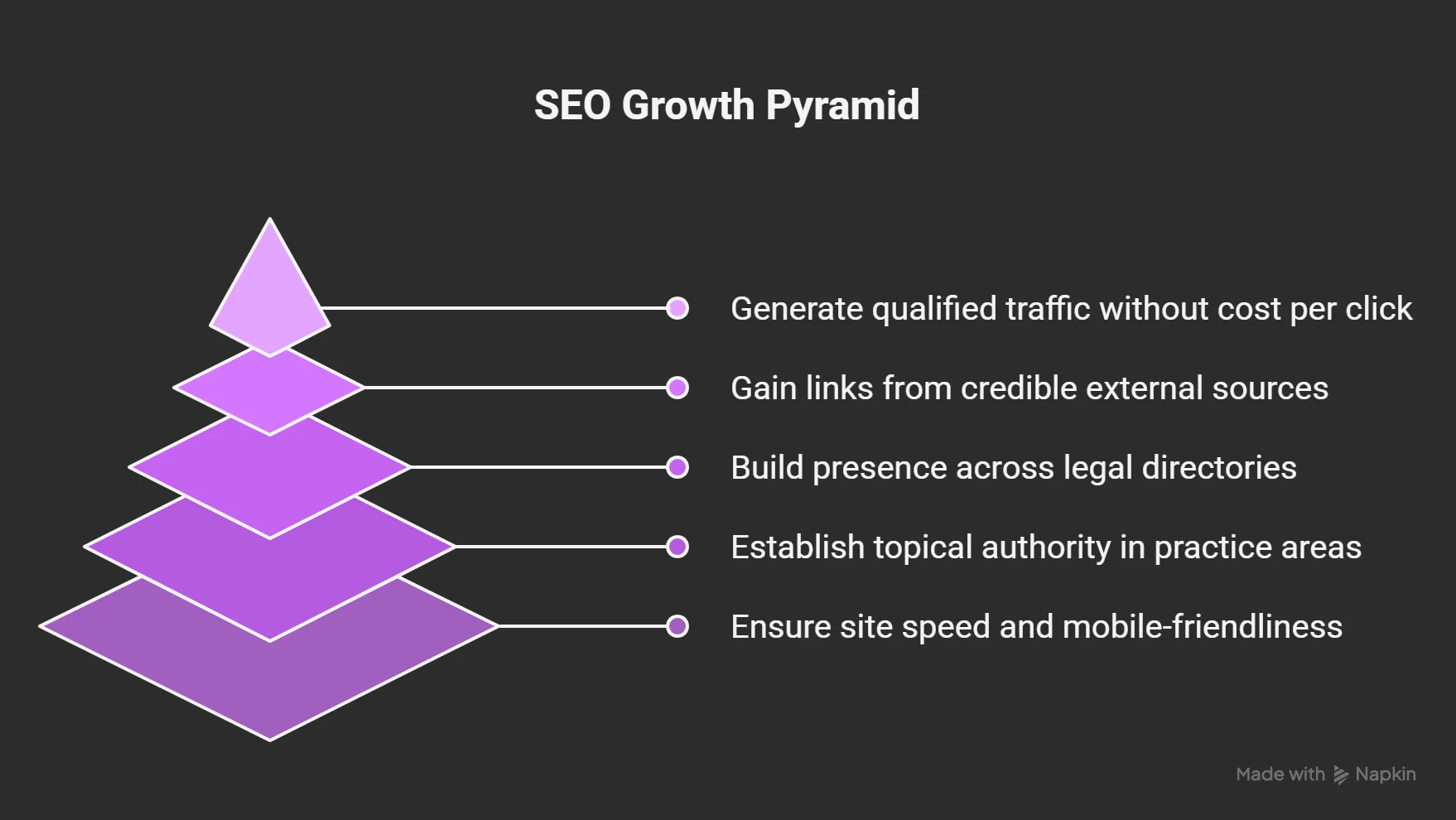
Effective law firm SEO includes a range of interconnected activities: technical audits to ensure the site loads quickly and is mobile-friendly, content creation that establishes topical authority across your practice areas, local citation building across legal directories, and link acquisition from credible external sources. These are not one-off tasks, they require ongoing investment and monitoring.
Firms that treat SEO as a strategic, long-term channel tend to reduce their dependency on paid advertising over time, as organic rankings provide a sustainable source of qualified traffic that costs nothing per visit. The upfront investment pays dividends for years.
3. Review Management: The Currency of Local Trust
Online reviews have become one of the most powerful forces in local business discovery — and law firms are no exception. Before a potential client picks up the phone, they will almost certainly check your Google Business Profile (formerly Google My Business) to see what previous clients have said about you. The volume, recency, and quality of your reviews directly influence whether they call you or scroll past to a competitor.
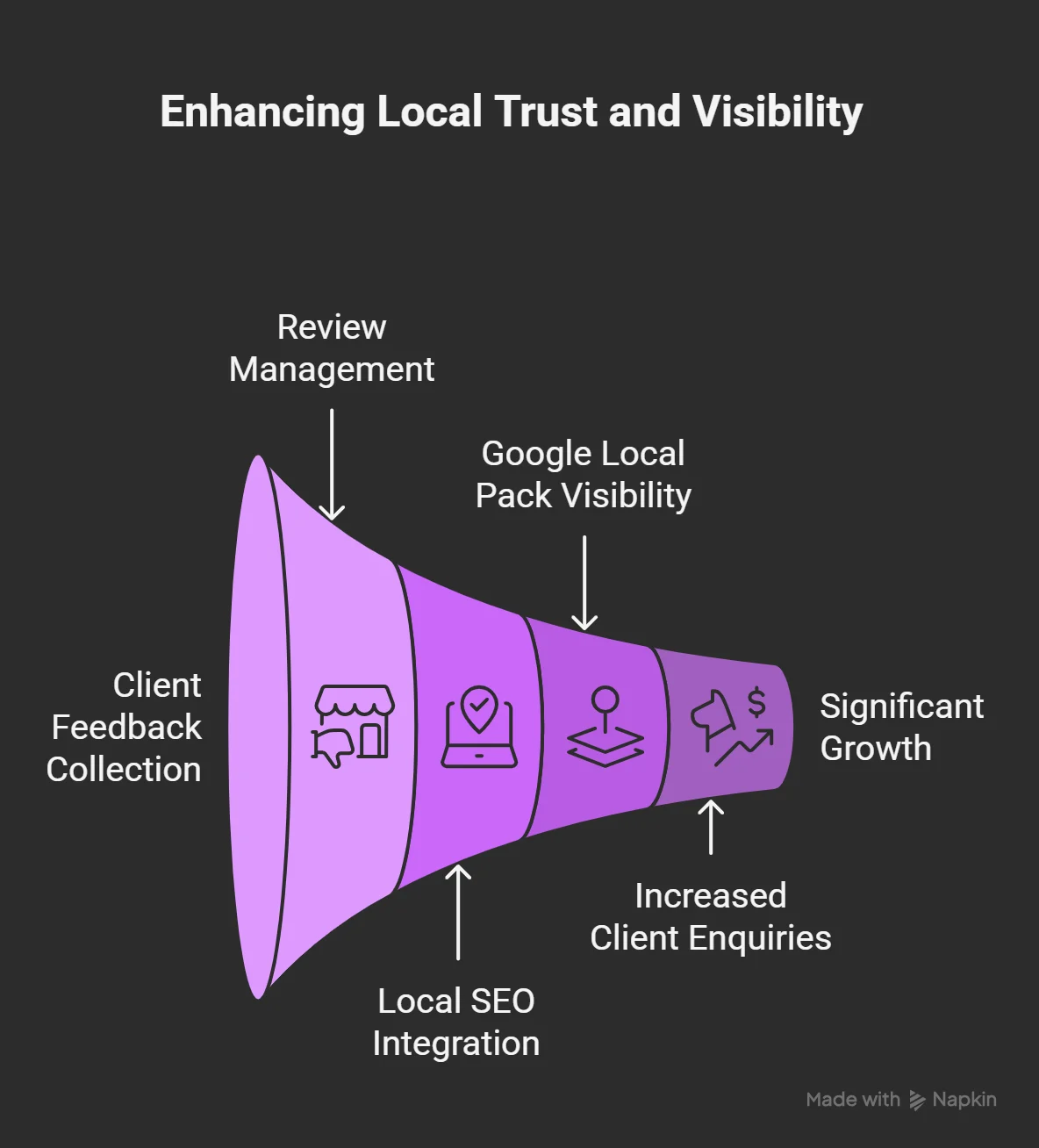
This is not just about social proof. Google uses review signals as a ranking factor in local search results. Firms with a strong, well-maintained review profile are more likely to appear in the Google Local Pack — the prominently displayed map-based listings that capture a significant proportion of local legal enquiries. Research into local SEO confirms that the volume and quality of reviews result in more clicks on your listing, which Google treats as a positive engagement signal that further reinforces your rankings.
Effective review management is not simply a matter of hoping satisfied clients leave feedback. It requires a proactive, systematic approach: asking clients for reviews at the right moment in the matter lifecycle, responding professionally to every review (positive and negative), and maintaining consistency across multiple platforms including Google, Trustpilot, and legal-specific directories.
Law firms implementing systematic review acquisition alongside broader local SEO strategies have reported client enquiry increases of 180% or more within six months, according to data published by Legal Brand Marketing. That figure underscores just how transformative a structured approach to reputation management can be for a firm that has previously relied on word of mouth alone.
4. Reviews and Online Presence in the Age of AI Search
The stakes around reviews and online presence are rising further still, thanks to a shift that is already reshaping how people find legal services: the rise of AI-powered search.
Tools like Google’s AI Overviews, ChatGPT, Perplexity, and other large language model platforms are increasingly being used by consumers to find and evaluate local businesses, including law firms. When someone asks an AI assistant “Who are the best family law solicitors in [city]?” the response is not a list of blue links. It is a synthesised answer that cites authoritative sources. The firms that appear in those citations are the ones that have built the strongest digital reputations.
As legal marketing experts have noted, visibility within an AI-generated answer is rapidly becoming a new key performance indicator for law firm marketing. AI tools factor in reputation signals from across the web — including Google reviews, legal directory listings, thought leadership content, and citations from other authoritative sources. Firms with thin online profiles, few reviews, and outdated websites are increasingly invisible in this new discovery channel.
This is sometimes referred to as Generative Engine Optimisation (GEO) — the practice of ensuring your firm’s content and online presence is structured in a way that AI tools can surface and cite. For high street firms, the practical implications are straightforward: keep your Google Business Profile fully optimised and up to date, maintain a steady flow of genuine client reviews, ensure your website contains detailed, well-written content about your practice areas, and build a consistent citation footprint across reputable legal and local directories.
The firms that act on this now, while most of their competitors are still ignoring it, will enjoy a significant first-mover advantage as AI-driven search continues to evolve.
Closing Thoughts: It Is Time to Reframe Marketing as Investment
The legal sector’s reluctance to invest meaningfully in marketing is understandable. It is a profession built on technical expertise, personal relationships, and trust — and many partners will tell you that their best clients have always come from referrals. But the referral landscape is changing. Clients are comparing firms online before they call anyone. AI is entering the discovery process. Competitors, particularly well-funded national firms and aggregators are investing heavily in digital visibility.
The firms that will thrive over the next five years are not necessarily the ones with the biggest budgets. They are the ones that make their marketing spend work hardest — through measurable PPC campaigns, long-term SEO investment, proactive review management, and a digital presence strong enough to be cited by the AI tools that are already shaping how clients find legal help.
The gap between what the legal sector spends on marketing and what comparable industries invest is not just a statistic. It is an opportunity — for the firms willing to close it.
Frequently Asked Questions
How much should a law firm spend on marketing?
Industry benchmarks suggest that UK law firms currently spend between 2% and 3.7% of turnover on marketing, with the average rising toward 3.1% according to the Law Firm Marketing Club’s Professional Services Marketing Survey. However, firms focused on growth — particularly in competitive areas like conveyancing or personal injury — often benefit from investing closer to 5–7% of revenue. The right figure depends on your growth ambitions, competitive environment, and the practice areas you are looking to develop.
Is PPC worth it for a small high street firm?
Yes — when managed properly by a legal sector specialist. PPC allows you to appear at the top of Google’s search results for highly specific, high-intent searches relevant to your practice areas. Even modest monthly budgets of £500 to £1,500 can generate a consistent flow of qualified enquiries. The key is expert campaign management, negative keyword strategies, and clear conversion tracking so you know exactly what your ad spend is producing.
How long does SEO take to produce results for a law firm?
SEO is a long-term investment. Most law firms begin to see meaningful improvements in organic rankings within three to six months of consistent SEO activity, with stronger results building over 12 to 18 months. Research suggests it takes an average of 14 months for law firms to fully recoup their SEO investment, but the compounding nature of organic rankings means that returns continue to grow well beyond that point, often delivering a three-year ROI of over 500%.
Why are Google reviews important for law firms?
Google reviews are important for two reasons. First, they are a direct ranking factor in local search — firms with more, better, and more recent reviews are more likely to appear in the Local Pack (the map-based results at the top of local searches). Second, they serve as powerful social proof for potential clients. Most people will check a firm’s reviews before making an enquiry. A consistent, positive review profile builds trust and significantly improves conversion rates from online discovery to consultation.
What is AI search and does it affect how clients find law firms?
AI-powered search tools — including Google’s AI Overviews, ChatGPT, Perplexity, and others — are increasingly being used by consumers to find and evaluate local services, including law firms. Rather than returning a list of links, these tools synthesise answers from across the web and cite authoritative sources. Firms with strong review profiles, well-structured websites, detailed practice area content, and consistent directory listings are more likely to be cited and recommended. Building this kind of digital presence now is one of the best investments a firm can make for long-term visibility.
What is the easiest first step to improve a law firm’s marketing?
A great starting point is your Google Business Profile. Ensuring it is fully completed, verified, and regularly updated — with accurate contact details, opening hours, photos, services, and a proactive approach to requesting client reviews — costs very little but can have an immediate impact on local visibility. From there, a marketing health check or SEO audit will give you a clear picture of where the biggest opportunities lie for your specific firm and practice areas.