



The way legal clients search, evaluate and appoint solicitors has changed significantly. It is digital, comparison-driven and more demanding than many firms realise. This article draws on data from our own client research, the Legal Services Consumer Panel, the SRA and BrightLocal to give you a clear picture of what clients actually expect in 2026 — and what your firm can do about it.
Ask law firm partners how clients typically find them and the answers haven’t changed much in decades: word of mouth, reputation, referrals. These still matter. But they no longer tell the whole story.
The way people search for, evaluate and ultimately appoint solicitors in the UK has undergone a fundamental shift. It is increasingly digital, far more research-driven and considerably more comparative than most firms assume.
Data from our own client research at GrowWithQS, the Legal Services Consumer Panel 2024/25 Tracker, SRA consumer polling and BrightLocal’s review studies all point to the same conclusion: modern legal consumers are informed, cautious and digitally confident. They research extensively, compare multiple providers, scrutinise pricing, and have very little tolerance for friction in the process.
For law firms, the question is no longer whether digital strategy and client experience matter. It is whether your firm is keeping pace with how clients behave.
How Clients Are Actually Finding Solicitors
Here is a statistic that should prompt every law firm to reassess its marketing: according to our own client research, 63% of clients found their solicitor online. The majority searched directly (around 55%), with a further 8% discovering firms through social media. Equally striking, 52% specifically looked for a local solicitor — meaning proximity still matters even in an era of remote working.
This is not a short-term blip. It reflects how the majority of prospective clients now identify legal support, often before they have ever heard of your firm’s name.
The SRA’s 2024 consumer polling reinforces this. Of 2,009 respondents, 30% had recently used a regulated legal service, and 90% of those chose a solicitor. Perhaps most revealing: almost half (47%) checked that their provider was properly regulated before proceeding. These are not passive consumers — they are doing their homework.
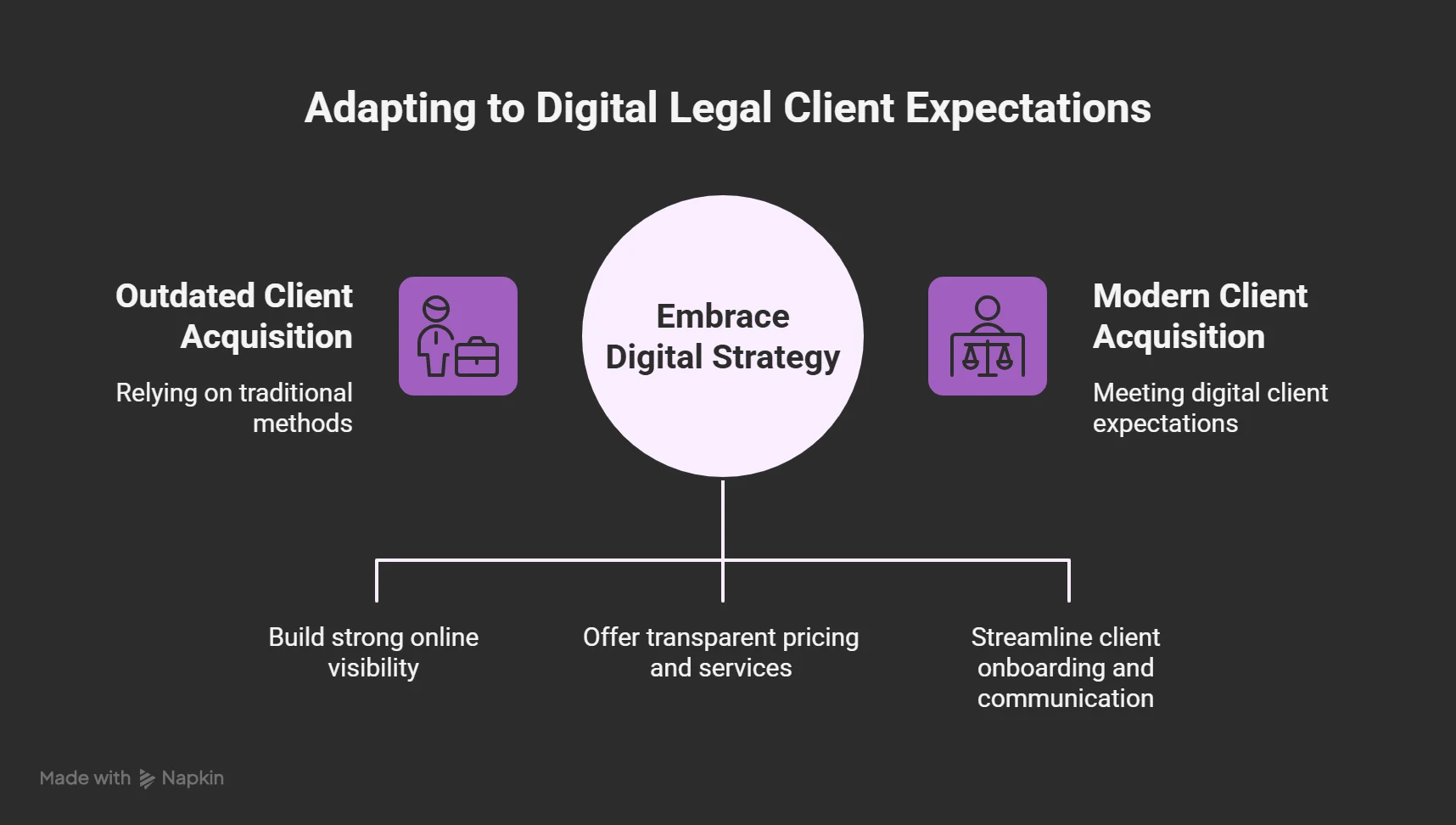
For firms looking to attract new instructions, digital presence is no longer optional. At a minimum, this means:
- Strong local SEO positioning in search results relevant to your practice areas
- An accurate, well-maintained Google Business Profile to capture ‘near me’ searches
- Social media activity that builds credibility and demonstrates expertise
- PPC campaigns targeting clients who are ready to instruct
Without these foundations, firms risk losing instructions to competitors who are simply more visible at the point of search.
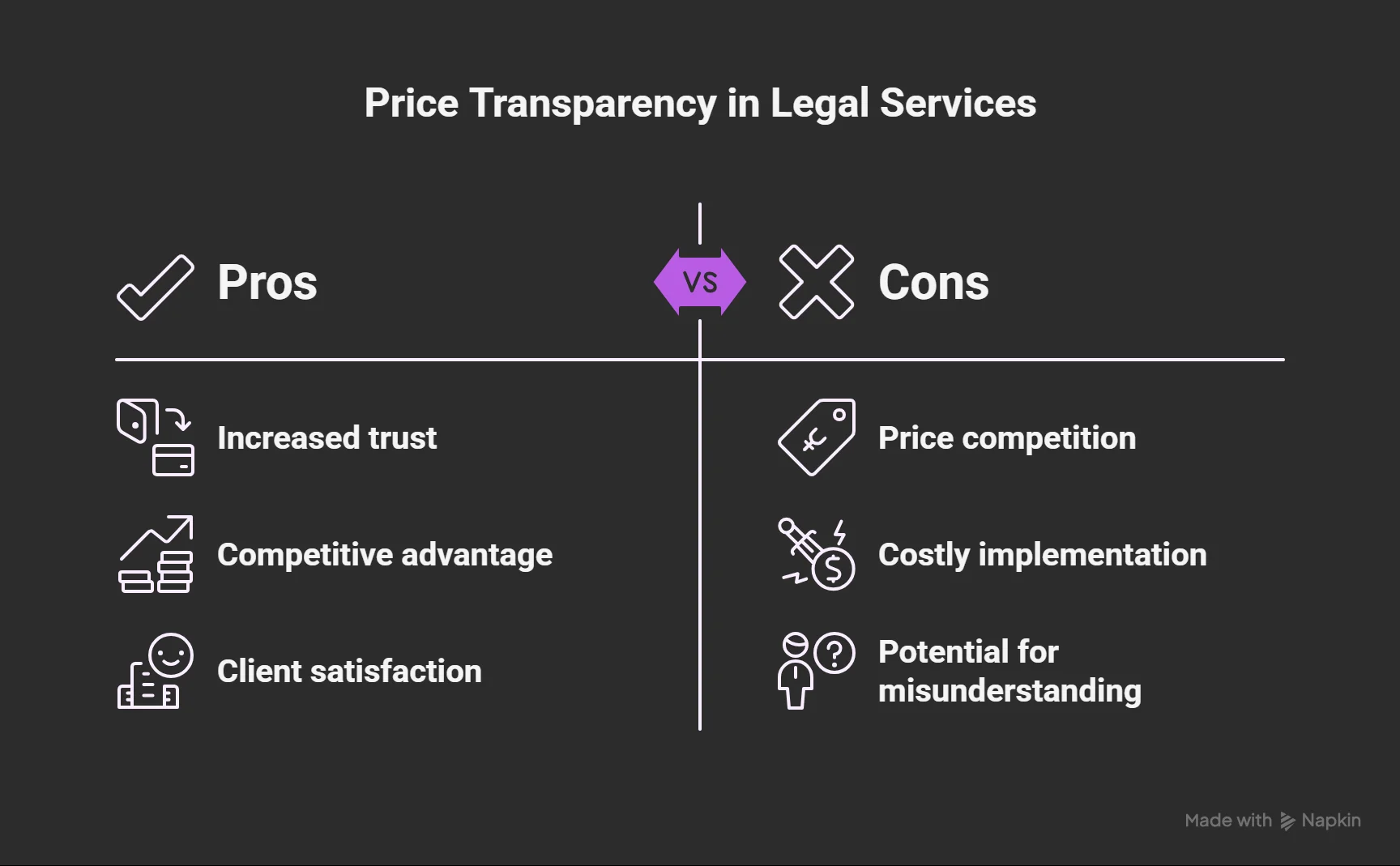
Price Transparency: Still a Gap — and a Significant Opportunity
When we asked clients what matters most when choosing a law firm, price came out clearly on top. Legal fees are often significant and, for many people, unexpected — so cost is a central consideration in the decision-making process.
Yet many firms are still falling short on transparency. The Legal Services Consumer Panel’s 2024/25 Annual Tracker found that only 38% of consumers saw price information before instructing a solicitor — and just 29% received a full breakdown of potential additional costs such as disbursements.
| 38% of legal consumers saw price information before instructing a solicitor Source: Legal Services Consumer Panel Tracker Survey, 2024/25 |
| 29% received a full breakdown of potential additional costs Source: Legal Services Consumer Panel Tracker Survey, 2024/25 |
SRA data shows what happens when transparency improves. Prior to the introduction of transparency rules, only 18% of firms published prices online. After implementation, that figure rose to 68% — and consumer behaviour shifted in parallel. Today, 55% of individuals and 60% of small businesses compare prices before selecting a solicitor.
Publishing your fees does not mean competing solely on cost. Clearly explaining what is included, setting expectations around additional charges, and presenting fees in plain English all strengthen credibility. Firms that communicate openly about pricing are consistently perceived as more professional and more trustworthy — and that perception is a decisive factor in client selection.
Clients Compare Options — Your Digital Presence Is Your First Impression
When a potential client finds your firm online, they rarely pick up the phone immediately. Our research shows that nearly one third of consumers review at least three different law firms before making contact. The SRA’s findings support this: comparison between providers is now standard client behaviour.
This comparison phase is where firms win or lose clients long before any conversation takes place. Prospective clients review websites, assess service information, evaluate tone and professionalism, and look closely at client feedback. Reviews are especially influential at this stage.
Every element of your firm’s digital presence — website content, online reviews, social media, case studies — shapes perception and influences whether a prospect goes on to make contact. If your online presentation does not inspire confidence, a competitor’s will.
Reputation Management: No Longer a Nice-to-Have
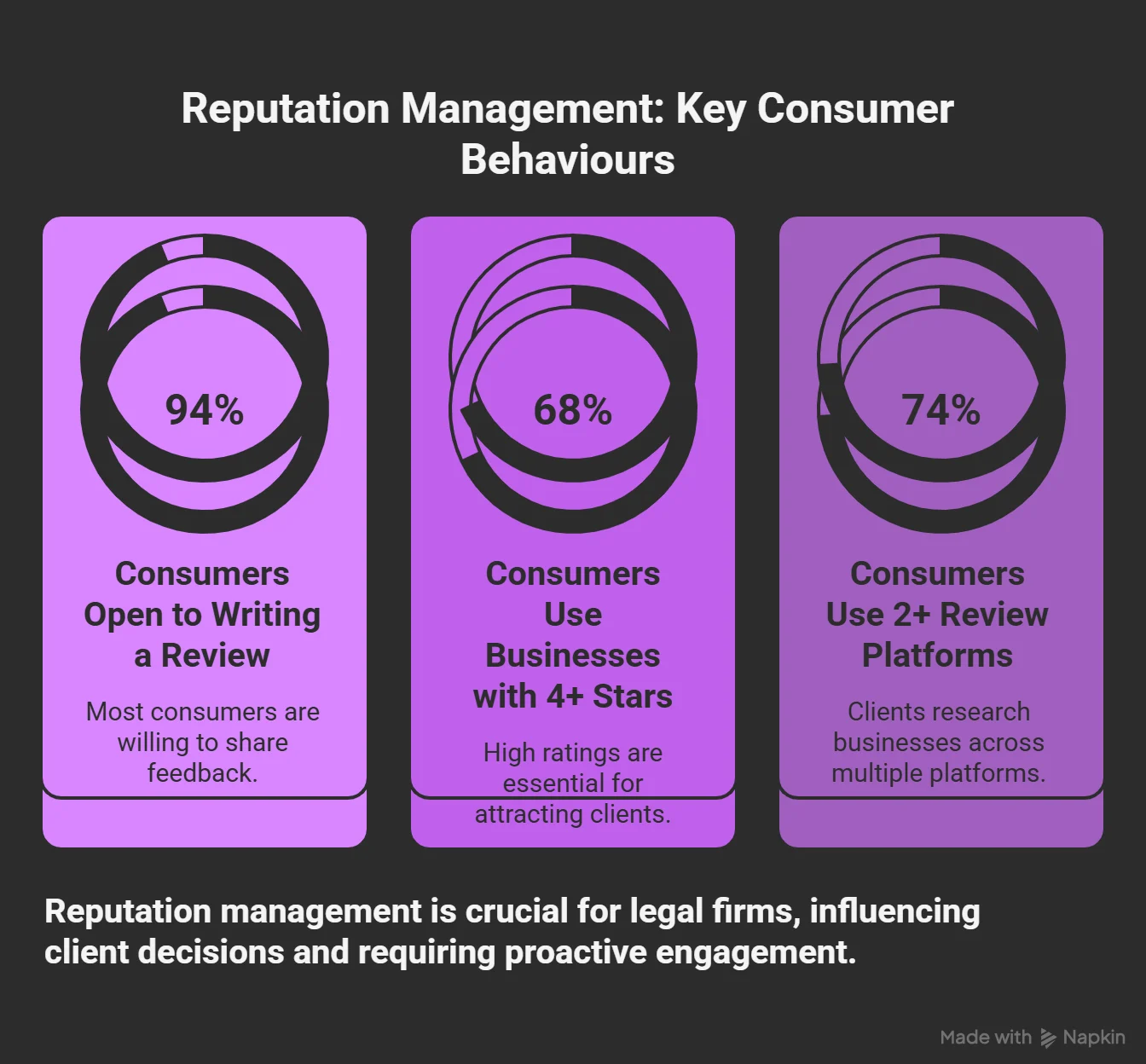
Online reviews have become a central component of legal marketing, and the scale of their influence is hard to overstate. BrightLocal’s 2025/26 Local Consumer Review Survey highlights the following:
| 94% of consumers are open to writing a review when asked Source: BrightLocal Local Consumer Review Survey, 2026 |
| 68% of consumers will only use a business with a rating of 4 stars or above Source: BrightLocal Local SEO Statistics, 2025 |
| 74% of consumers use at least two review platforms when researching a business Source: BrightLocal Local SEO Statistics, 2025 |
Google remains the leading review platform, followed by Facebook and Yelp. For law firms, maintaining a strong, actively managed Google profile — with consistent, recent reviews — is essential.
Reputation management is not a passive outcome of delivering good work. It is an operational function that requires a systematic approach to requesting, monitoring and responding to reviews. Firms that treat this proactively are at a significant advantage.
| Want to understand exactly what your clients are looking for? Our free guide brings together research and real-world data to help your firm attract more clients, build trust, and compete more effectively in 2026. Download the free guide: Understanding Your Clients → |
Service Quality and Complaints: The Reputation Risk That Is Often Overlooked
The Legal Ombudsman’s 2024/25 annual data make for uncomfortable reading. New complaints accepted rose to 7,203 — an 8% year-on-year increase. Poor service findings were made in 70% of investigated cases, up from 65% in 2022/23. Poor complaint handling was identified in 49% of cases.
| 70% of investigated cases resulted in a poor service finding — up from 65% in 2022/23 Source: Legal Ombudsman Annual Complaints Data, 2024/25 |
Separately, SRA research reports that 87% of clients were satisfied with their legal services in 2024. That is encouraging — but it also means roughly one in eight clients had a negative experience. Dissatisfied clients are significantly more likely to share their experiences publicly, particularly through online reviews.
Maintaining a strong reputation requires consistent service standards, clear communication and an effective approach to complaints — not just at the point of instruction, but throughout the entire client journey.
Responsiveness: The Factor That Decides Who Gets the Instruction
Our research shows that 70% of clients contacted more than one law firm before engaging one. This reflects a desire to compare options — but it also means responsiveness becomes a competitive differentiator.
Clients expect prompt replies and clear communication. Delays, limited accessibility or an unhelpful first interaction frequently result in lost instructions. Where multiple firms are approached simultaneously, the firm that responds first with a clear, helpful answer often wins the work — regardless of other factors.
Contactability goes well beyond listing a phone number on your website. Firms that offer multi-channel accessibility, timely follow-up and, where appropriate, out-of-hours responsiveness are better placed to convert enquiries into instructions.
Local vs. National: Understanding How Far Clients Will Travel
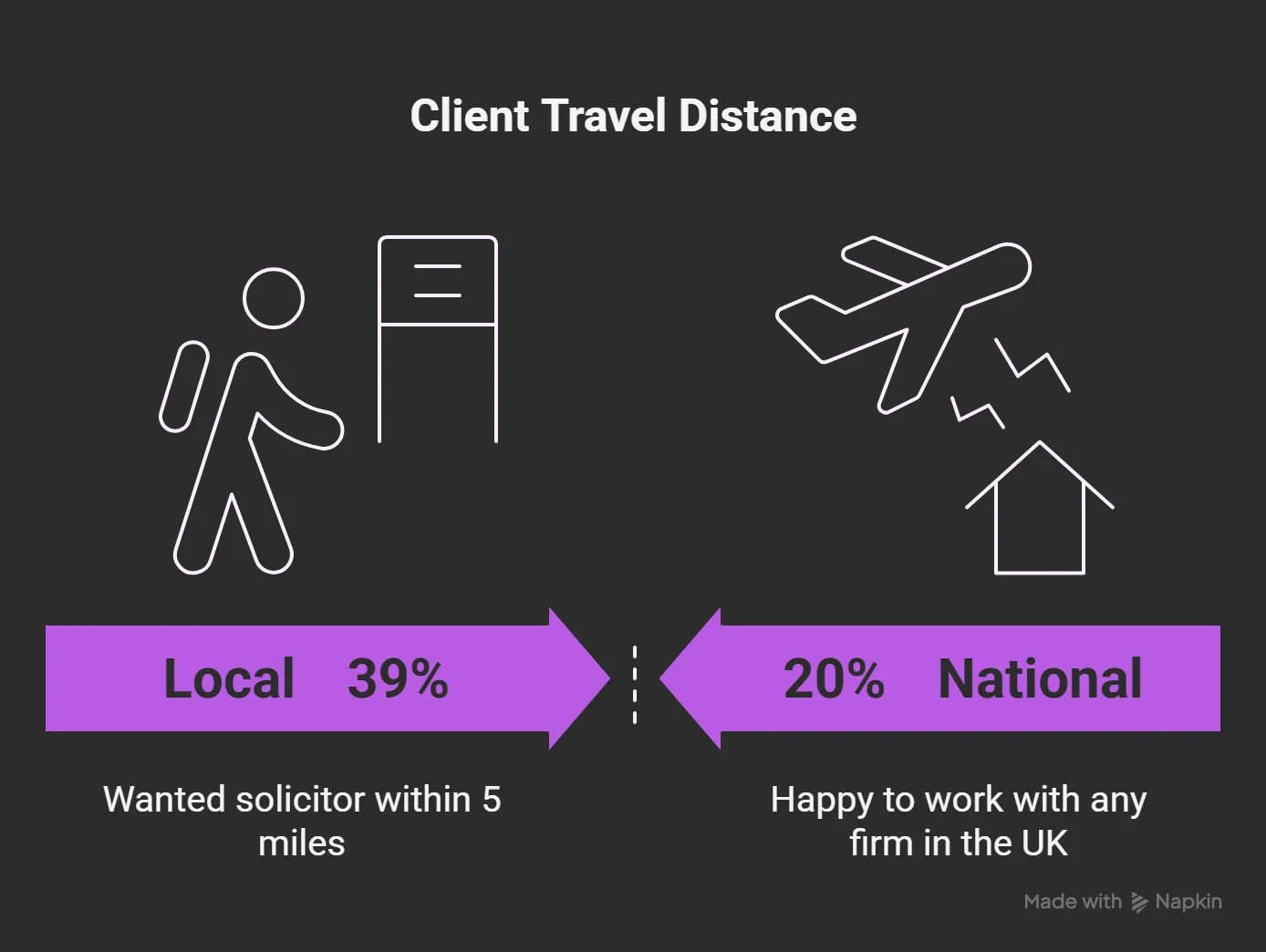
Proximity continues to matter for most legal consumers, as our client data makes clear:
| 39% wanted their solicitor to be within 5 miles Source: GrowWithQS client research |
| 25% were willing to work with a firm within 5–10 miles Source: GrowWithQS client research |
| 20% said they were happy to work with any firm in the UK Source: GrowWithQS client research |
This reinforces the importance of local SEO, a strong community presence and an optimised Google Business Profile for most firms. But the 20% willing to instruct nationally is a meaningful and growing opportunity.
With video consultations, secure client portals and digital document signing now standard practice, geographic limitations have reduced significantly. Firms with strong digital infrastructure, a compelling online presence and an actively managed reputation can reach well beyond their traditional catchment area.
What Today’s Legal Client Actually Looks Like
Drawing together our research and wider sector data, the picture of a modern legal client looks like this:
- Finds solicitors primarily through online search, with a preference for local results
- Compares at least three firms before making contact
- Expects clear, accessible pricing information before instructing
- Reviews ratings and feedback across more than one platform
- Contacts several firms simultaneously and assesses responsiveness
- Values both personal recommendations and verified online reviews
- Expects consistent, professional service from first contact through to completion
The Legal Services Consumer Panel also highlights that vulnerable clients — including non-English speakers and those with lower digital confidence — face greater challenges navigating the legal market. Firms that prioritise accessibility, plain-English communication and multi-channel contact options are not only improving their own competitiveness. They are contributing to fairer access to legal services.
The Strategic Priorities for Growth-Focused Firms in 2026
The evidence consistently points in one direction. Firms positioned for sustainable growth are those that:
- Understand digital client behaviour and invest accordingly in visibility
- Demonstrate genuine pricing transparency throughout the client journey
- Respond promptly and professionally to every enquiry
- Actively manage their online reputation rather than leaving it to chance
- Deliver consistent, high-quality service that earns reviews and referrals
The Clio 2025 Legal Trends Report supports this. Firms that focused on operational efficiency significantly increased revenue over four years — not only by attracting more clients, but by managing matters more effectively. Marketing performance and operational systems are more closely linked than many firms recognise.
Frequently Asked Questions
How do most clients find a solicitor in the UK?
Online search is now the primary route, with our research showing that 63% of clients found their solicitor this way. Most searched directly, while a smaller proportion came through social media. Word of mouth and referrals remain important, but they no longer dominate the picture as they once did.
Do clients compare law firms before choosing one?
Yes. Almost a third of legal consumers review at least three firms before making contact, and 70% contact more than one firm simultaneously. Comparison is now standard behaviour. Your firm’s website, reviews and pricing information will all be assessed before a client ever reaches out.
How important are online reviews for law firms?
Extremely important. 68% of consumers will not use a business with a rating below 4 stars, and 74% consult at least two review platforms before making a decision. Google is the most influential review platform, so maintaining a strong, up-to-date Google profile is essential for most firms.
Should law firms publish their fees online?
Yes — and not just because it is increasingly expected by the regulator. Firms that publish transparent, easy-to-understand pricing are perceived as more trustworthy and professional. Only 38% of consumers currently see pricing before instructing, which means firms that do this well stand out from the majority.
How quickly should a law firm respond to enquiries?
As quickly as possible. Given that most clients contact multiple firms simultaneously, responsiveness often determines who wins the instruction. A prompt, clear and helpful first response — even if a full consultation needs to be scheduled — signals professionalism and builds confidence.
Is it worth targeting clients outside my local area?
For the right practices, yes. While 64% of clients still prefer a local solicitor, 20% are willing to instruct any firm in the UK. With video consultations and digital processes now commonplace, geographic barriers have reduced. Firms with strong digital infrastructure and clear online propositions are well placed to attract clients beyond their immediate area.
| Want to understand exactly what your clients are looking for? Our free guide brings together research and real-world data to help your firm attract more clients, build trust, and compete more effectively in 2026. Download the free guide: Understanding Your Clients → |
Final Thought: Know Your Client, Earn Their Trust
Today’s legal clients research extensively before making contact. They compare firms, scrutinise pricing, examine feedback and assess responsiveness — often before they have spoken to anyone. Their judgement continues throughout the engagement and frequently concludes with a public review.
The firms best positioned for 2026 are those that align with this behaviour: visible in search, transparent about fees, accessible when clients reach out and consistent in the service they deliver.
Understanding your clients is no longer a marketing exercise. It is a strategic imperative. If you would like to go deeper on the data and how it applies to your firm, download our free guide: Understanding Your Clients.